
There was a time when the word “vulnerable” carried real weight. It conjured images of a knight with a chink in his armor, or a shy confession shared over candlelight. It meant something. It had stakes. If someone said, “I feel vulnerable,” you didn’t check your watch—you leaned in.
Now? The word “vulnerable” has been stretched so thin it could double as a city-issued tarp.
In today’s civic vocabulary, “vulnerable” has become the Swiss Army knife of descriptors—useful for everything, precise for nothing. Politicians use it, nonprofits use it, your neighbor uses it, and somewhere along the line, it has become the go-to label for nearly every discussion about homelessness, public space, and policy. Particularly when discussing the growing number of people living on sidewalks, the word shows up so often it might as well have its own tent permit.
Let’s be clear: there are absolutely people in society who are vulnerable in the truest sense—physically, mentally, economically. That’s not up for debate. But when every single person in a sprawling sidewalk encampment is described with the same word, something curious happens: the word stops clarifying and starts obscuring.
Imagine if every restaurant review simply said, “The food was edible.” Technically true, perhaps, but not exactly helpful. Was it a five-star experience or a regret sandwich? Who knows! It was… edible.
That’s where we are with “vulnerable.”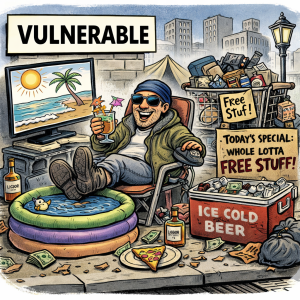
Take a stroll down a city block these days and you might encounter a complex mix of situations: someone down on their luck, someone struggling with addiction, someone dealing with severe mental illness, and yes, someone who has simply decided that rent is an optional lifestyle choice. Yet in official language, they are all bundled together under the same soft, blanket term: vulnerable.
It’s the linguistic equivalent of putting everything in your garage into a box labeled “stuff.” Technically accurate, wildly unhelpful.
The humor—if one can call it that—comes from how the word is deployed in conversations about public space. Sidewalks, once intended for walking, have become multipurpose zones: part campsite, part storage unit, part philosophical statement about modern society. And when residents raise concerns—about access, safety, or, say, the sudden appearance of a sofa where a sidewalk used to be—the response often begins with a solemn invocation: “We must remember, these are vulnerable individuals.”
At which point the word “vulnerable” floats into the air like a linguistic hall pass, quietly excusing any further questions.
It’s a remarkable trick. The word has become so emotionally loaded that it can end discussions before they begin. Raise a concern about blocked sidewalks? Vulnerable. Ask about sanitation? Vulnerable. Wonder aloud how a full-size refrigerator arrived on a curb? Extremely vulnerable refrigerator.
Of course, humor aside, this overuse creates a real problem. When one word is used to describe a wide range of circumstances, it flattens the conversation. It becomes harder to distinguish between someone who needs temporary assistance and someone in the grip of a long-term crisis. It muddies the waters of policy, making targeted solutions more difficult because everything is treated as the same shade of need.
And ironically, it may even do a disservice to the very people it aims to protect. If everyone is labeled “vulnerable,” then no one’s specific vulnerabilities stand out. It’s like a medical chart that lists every patient’s condition as “unwell.” Accurate, sure—but not exactly a roadmap for treatment.
There’s also the curious way the word has crept into everyday speech. People now announce they’re being “vulnerable” when sharing that they prefer oat milk, or that they once cried during a commercial. The bar for vulnerability has been lowered so far that stubbing your toe might qualify as an emotional breakthrough.
Meanwhile, out on the sidewalks, the word continues its tireless work, doing the heavy lifting of avoiding more precise language. Because precision, after all, requires effort—and occasionally, uncomfortable honesty.
So what’s the alternative? It’s not about abandoning compassion or empathy. Quite the opposite. It’s about using language that reflects reality in all its messy complexity. Words like “struggling,” “displaced,” “addicted,” “mentally ill,” or even “noncompliant” may lack the gentle glow of “vulnerable,” but they carry information. They tell us something useful. They point toward solutions rather than smoothing everything into a single, indistinct category.
In the end, “vulnerable” isn’t a bad word. It’s just an overworked one. It’s been asked to do too much, to cover too many situations, to stand in for conversations we’re not quite sure how to have.
Perhaps it deserves a break. A nice, quiet retirement. Somewhere far from policy meetings and press releases. Maybe even a little place of its own—on a sidewalk, of course—where it can finally rest, undisturbed, and no longer responsible for explaining absolutely everything.
 in Silicon Valley—have traveled globally like missionary devices. You try to buy a croissant in Portugal? The screen spins around dramatically, presenting you with a choice between 15%, 20%, and “Are you sure you’re not a bad person?” Europeans stare at it in confusion. Americans instinctively press the biggest number.